
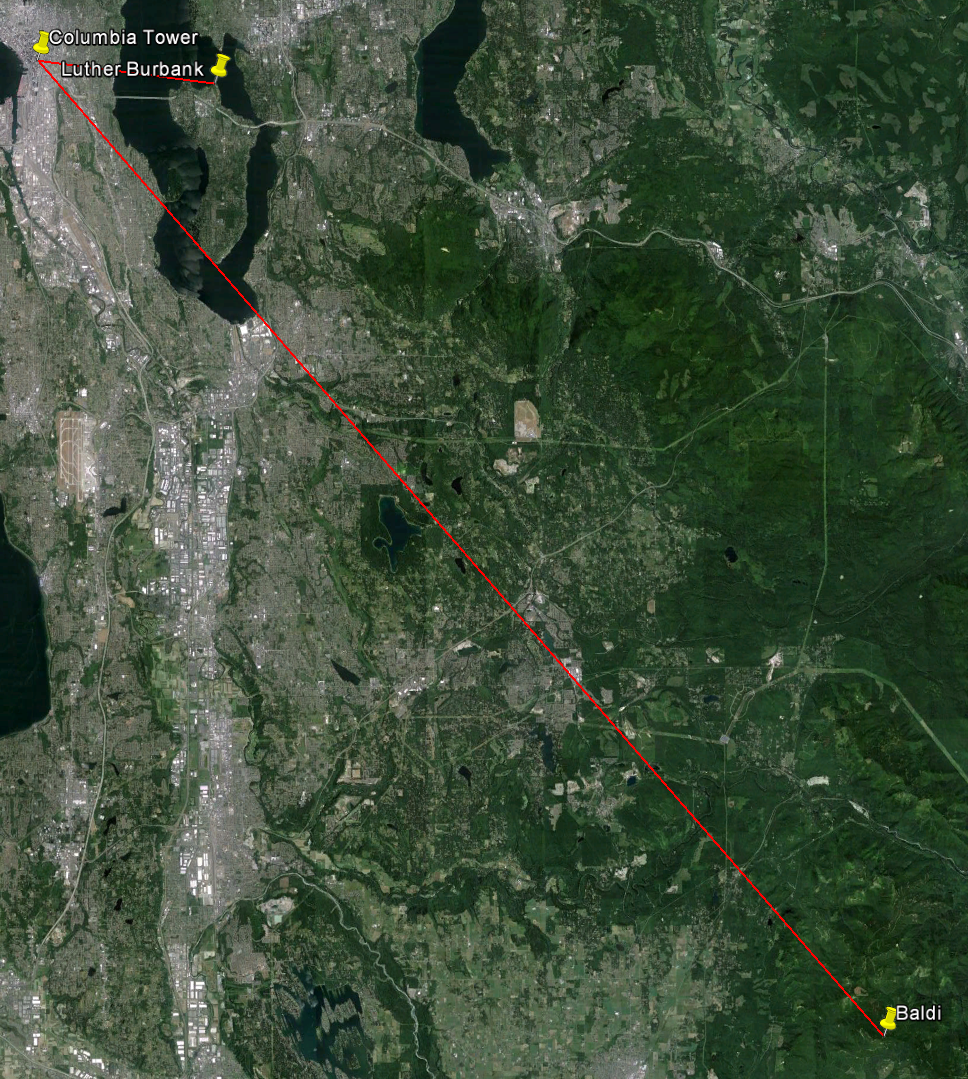
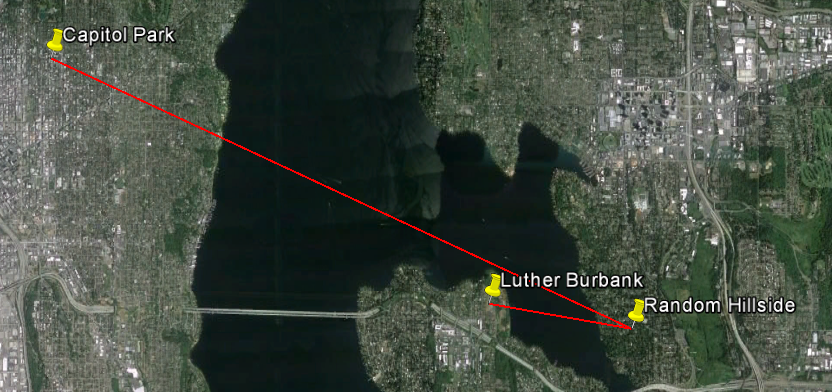
Hello, Today I participated in a HamWAN field test for the upcoming Field Day event @ Luther Burbank park. During the testing, a couple very interesting working RF paths surfaced. Here is the most impressive one: We had setup a dish at the northern tip of Luther Burbank Park, and aimed it at downtown Seattle (around Columbia Tower). We picked up a signal from Baldi-S1! The measured distance (time of flight measurement) was 67km. This means the RF was bouncing off of downtown Seattle and heading all the way out to Baldi by Enumclaw! The data throughput measured was about 1.2Mbit each way average, peaking at 1.5Mbit. We moved the dish atop the hill at the park, pointed it at Baldi through a narrow opening in the closer hill ridges, and did a follow-up test. The measured distance (time of flight measurement) in that direct test was 56km: an 11km difference! The measures aren't very accurate, so the 3km error compared to real physical distance is within the expected error range. Keep in mind that 3km is only 10 microseconds in terms of RF signal flight. Feeling inspired by this astounding Baldi result, we decided to test a reflected RF path to the Capitol Park cell site: We pointed the dish at a random hillside across the water from Luther Burbank, and picked up Capitol Park @ up to -73dBm. Bouncing off this hillside we got 3.5Mbit download and 5Mbit upload speeds to the Internet. I guess the lesson here is: If you don't have a direct path to a HamWAN cell site, perhaps you can try playing with some indirect reflected paths to get connected! --Bart

On 6/6/15 9:03 PM, Bart Kus wrote:
We pointed the dish at a random hillside across the water from Luther Burbank, and picked up Capitol Park @ up to -73dBm. Bouncing off this hillside we got 3.5Mbit download and 5Mbit upload speeds to the Internet.
I guess the lesson here is: If you don't have a direct path to a HamWAN cell site, perhaps you can try playing with some indirect reflected paths to get connected!
Very cool! Bart, are these dual pol links or vertical only? If they are vertical only, did you try switching to horizontal at your client end? Generally a single reflection will cause a 90 degree shift in polarization. Some times over multiple ones you can have some fun things happen that you can't model. Also in most cases a passive reflector is only going to be useful if one station is very close to it with the other being further away. 73's W9CR -- Bryan Fields 727-409-1194 - Voice 727-214-2508 - Fax http://bryanfields.net

Very cool stuff Bart. Those are some very promising results I think for a number of people. Bryan, Both of the sectors he referenced are horizontally polarized (we don’t have dual pol sectors installed there yet). I don’t know what orientation he had his client antenna, or if it was a dual pol client. It would be interesting to hear. Nigel
On Jun 6, 2015, at 18:09, Bryan Fields <Bryan@bryanfields.net> wrote:
On 6/6/15 9:03 PM, Bart Kus wrote:
We pointed the dish at a random hillside across the water from Luther Burbank, and picked up Capitol Park @ up to -73dBm. Bouncing off this hillside we got 3.5Mbit download and 5Mbit upload speeds to the Internet.
I guess the lesson here is: If you don't have a direct path to a HamWAN cell site, perhaps you can try playing with some indirect reflected paths to get connected!
Very cool!
Bart, are these dual pol links or vertical only? If they are vertical only, did you try switching to horizontal at your client end?
Generally a single reflection will cause a 90 degree shift in polarization. Some times over multiple ones you can have some fun things happen that you can't model.
Also in most cases a passive reflector is only going to be useful if one station is very close to it with the other being further away.
73's W9CR -- Bryan Fields
727-409-1194 - Voice 727-214-2508 - Fax http://bryanfields.net _______________________________________________ PSDR mailing list PSDR@hamwan.org http://mail.hamwan.net/mailman/listinfo/psdr
I was using an HPol 30dBi Poynting grid antenna along with a Metal 5SHPn modem. Both the cell sites are just HPol, as Nigel mentioned. Did not try switching polarity. I'm not aware of the polarity rotation from a single reflection. Do you have any docs that explain the physics behind that? I'm not seeing why that would need to be true. --Bart On 6/6/2015 6:16 PM, Nigel Vander Houwen wrote:
Very cool stuff Bart. Those are some very promising results I think for a number of people.
Bryan, Both of the sectors he referenced are horizontally polarized (we don’t have dual pol sectors installed there yet). I don’t know what orientation he had his client antenna, or if it was a dual pol client. It would be interesting to hear.
Nigel
On Jun 6, 2015, at 18:09, Bryan Fields <Bryan@bryanfields.net> wrote:
On 6/6/15 9:03 PM, Bart Kus wrote:
We pointed the dish at a random hillside across the water from Luther Burbank, and picked up Capitol Park @ up to -73dBm. Bouncing off this hillside we got 3.5Mbit download and 5Mbit upload speeds to the Internet.
I guess the lesson here is: If you don't have a direct path to a HamWAN cell site, perhaps you can try playing with some indirect reflected paths to get connected! Very cool!
Bart, are these dual pol links or vertical only? If they are vertical only, did you try switching to horizontal at your client end?
Generally a single reflection will cause a 90 degree shift in polarization. Some times over multiple ones you can have some fun things happen that you can't model.
Also in most cases a passive reflector is only going to be useful if one station is very close to it with the other being further away.
73's W9CR -- Bryan Fields
727-409-1194 - Voice 727-214-2508 - Fax http://bryanfields.net _______________________________________________ PSDR mailing list PSDR@hamwan.org http://mail.hamwan.net/mailman/listinfo/psdr
PSDR mailing list PSDR@hamwan.org http://mail.hamwan.net/mailman/listinfo/psdr
On 6/6/15 9:25 PM, Bart Kus wrote:
I'm not aware of the polarity rotation from a single reflection. Do you have any docs that explain the physics behind that? I'm not seeing why that would need to be true.
It's not a hard 90 degree shift as I recalled, it varies. I've never put in a passive repeater so it was taught to me, and never used. Check out page 77 of this PDF http://az276019.vo.msecnd.net/valmontstaging/vsna-resources/microflect-passi... -- Bryan Fields 727-409-1194 - Voice 727-214-2508 - Fax http://bryanfields.net

We in Memphis have had lots of luck using urban buildings as passive reflectors, too. Our longest link yet here was made possible by one! We also have HamWAN coverage downtown Memphis all thanks to reflections. Glad that you had such luck, Bart. On Sat, Jun 6, 2015, 20:09 Bryan Fields <Bryan@bryanfields.net> wrote:
On 6/6/15 9:03 PM, Bart Kus wrote:
We pointed the dish at a random hillside across the water from Luther Burbank, and picked up Capitol Park @ up to -73dBm. Bouncing off this hillside we got 3.5Mbit download and 5Mbit upload speeds to the Internet.
I guess the lesson here is: If you don't have a direct path to a HamWAN cell site, perhaps you can try playing with some indirect reflected paths to get connected!
Very cool!
Bart, are these dual pol links or vertical only? If they are vertical only, did you try switching to horizontal at your client end?
Generally a single reflection will cause a 90 degree shift in polarization. Some times over multiple ones you can have some fun things happen that you can't model.
Also in most cases a passive reflector is only going to be useful if one station is very close to it with the other being further away.
73's W9CR -- Bryan Fields
727-409-1194 - Voice 727-214-2508 - Fax http://bryanfields.net _______________________________________________ PSDR mailing list PSDR@hamwan.org http://mail.hamwan.net/mailman/listinfo/psdr
participants (4)
-
 Bart Kus
 -
 Bryan Fields
 -
 Nigel Vander Houwen
 -
 Ryan Elliott Turner